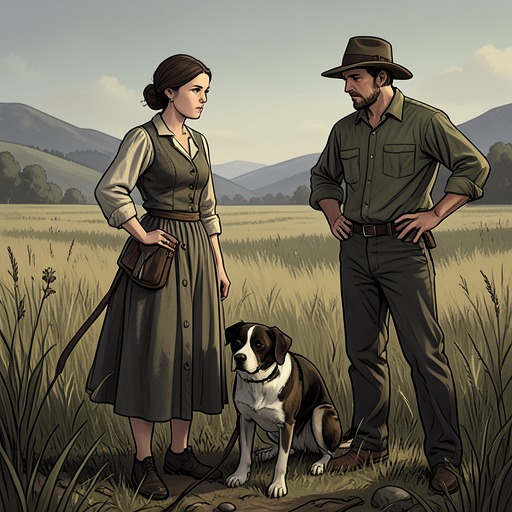
Animal dominion and naming
The FriendAnimal dominion and naming describes how the power to name animals can signify a broader claim of human authority over them. The idea runs from objections to calling animals pets, through the contrast between Dogs and Cats, to Ursula K. Le Guin’s story in which Eve persuades animals to surrender their names. Naming is presented not as a neutral convenience but as a possible instrument of separation; undoing it offers a way to imagine kinship without dominion, though at the cost of shared human language.
Dominion and the Language of Ownership
Some people object strongly to naming pets, and their objection belongs to a larger unease with the language used to describe human-animal relations. They dislike the word pet, resist owner, and react most strongly to master. These terms differ in tone, but each can suggest that an animal belongs within a human system of control. The passage identifies the underlying problem as dominion: the claim that humanity has a God-given right to rule animals, a claim that these objectors regard as a form of enslavement.
The range of contested words matters because it makes the idea of power visible in ordinary speech. Calling an animal a pet may sound affectionate, while calling a person its master sounds more plainly hierarchical; the objections gathered here connect both kinds of language to the same structure. The account does not settle the debate by treating every term as identical. Instead, it shows how naming and ownership can become linked when humans assume the authority to define an animal’s place and purpose.
Dogs, Cats, and Domestication
The speaker clarifies that a stated preference for Cats does not mean Cats are liked better: the two species are liked about equally. The distinction is between affection and unease. Canine devotion unsettles the speaker, while the prospect of dominating an animal troubles many people. The discussion therefore resists reading a preference as a simple ranking of species; it concerns the human position in a relationship, not which animal is more lovable.
That discomfort is given a concrete basis in domestication. Dogs, like other domesticated animals, have been bred to be dominated by people, used by them, and made to do what people want. The blunt qualification that Cats are different interrupts any easy generalization from Dogs to all animals. It also sharpens the issue: human control is not merely a matter of how an individual owner behaves, but is built into the histories and purposes of some domesticated animals. At the same time, the passage does not explain the difference between Cats and Dogs further, leaving the contrast pointed but deliberately brief.
Adam’s First Act of Naming
The account connects naming to the story of creation. Everyone knows, it says, that Adam’s first act with the animals formed by the Lord from the newly created earth was to give each one a name. Naming thus becomes the first sign of Adam’s dominion: before any later human use of animals enters the discussion, the act of identifying them establishes a relation in which one party names and the others receive names.
The passage adds a more radical possibility, carefully attributing it to some: until Adam named the animals, they did not exist. That claim makes the stakes of naming larger than classification. If an animal’s existence is understood to begin only when a human names it, human language appears to grant life and recognition at once, placing humans in the position of defining what counts as real. The idea is presented as a belief, not an established fact, and its force lies in exposing how thoroughly the human act of naming can be mistaken for the source of an animal’s being.
Eve’s Unnaming and Its Cost
Le Guin’s story reverses the creation account through a woman who is not named in the story but is unmistakably Adam’s partner, Eve. She persuades the animals to give up the names assigned to them. Cats claim that they never accepted those names in the first place, a small resistance that makes their position distinct even within a story organized around collective renunciation. Unnaming is not simply Eve substituting one system of labels for another: the animals are asked to relinquish the human names themselves.
Eve experiences the result as the lowering of a wall and the closing of a distance between herself and the animals. Namelessness brings a new sense of oneness and equality, undoing the separation that names had helped maintain. The change reaches beyond the human-animal divide: without names, the distinctions between hunter and hunted, eater and food also fall away. The story therefore imagines a world in which linguistic boundaries no longer arrange living beings into opposed roles, even as it leaves the implications of that transformation within the story’s own terms.
The next step is more costly for Eve. She returns to Adam the name he and his father gave her, leaves Adam, and joins the other nameless beings, who have freed themselves from domination by accepting namelessness. Unlike the animals, however, Eve must also give up the language she shared with Adam. Her stated reason for beginning the act helps explain the severance: talk had been getting them nowhere. The ending makes liberation inseparable from a loss of communication. Unnaming offers equality and escape from human control, but it does not preserve the language through which Eve’s relationship with Adam had been conducted.
Significance
The juxtaposition of everyday debates about pets with the creation story and Le Guin’s reversal gives naming two connected meanings: it can recognize an animal, but it can also assert a human right to define and possess it. The Cats’ refusal to acknowledge that they accepted names in Le Guin’s tale complicates any account in which animals are merely passive recipients of human labels. Across the discussion, animals appear not only as objects of human affection or use but as beings whose relation to imposed names is not fully controlled by human speech.
The concept remains unresolved rather than offering a practical rule about whether people should name animals. Its central tension is that language makes distinctions possible, while those distinctions may reinforce the hierarchy they describe. Eve’s departure carries that tension to its limit: refusing domination means relinquishing not only a name but a shared human language. The story thus makes the imagined equality of humans and animals powerful precisely because it is not presented as cost-free.